

Language

Language
Custom Luxury Gift Boxes & Bags: Millimetre Standards, Brand Value Delivered
Whether a box can justify a brand's price point comes down to three things: whether the sample matches the vision, whether colour consistency holds, and whether delivery is on time. There are no shortcuts here—only equipment, experience, and signing off on sample after sample. Below, we break down how we approach custom high-end gift boxes and bags.
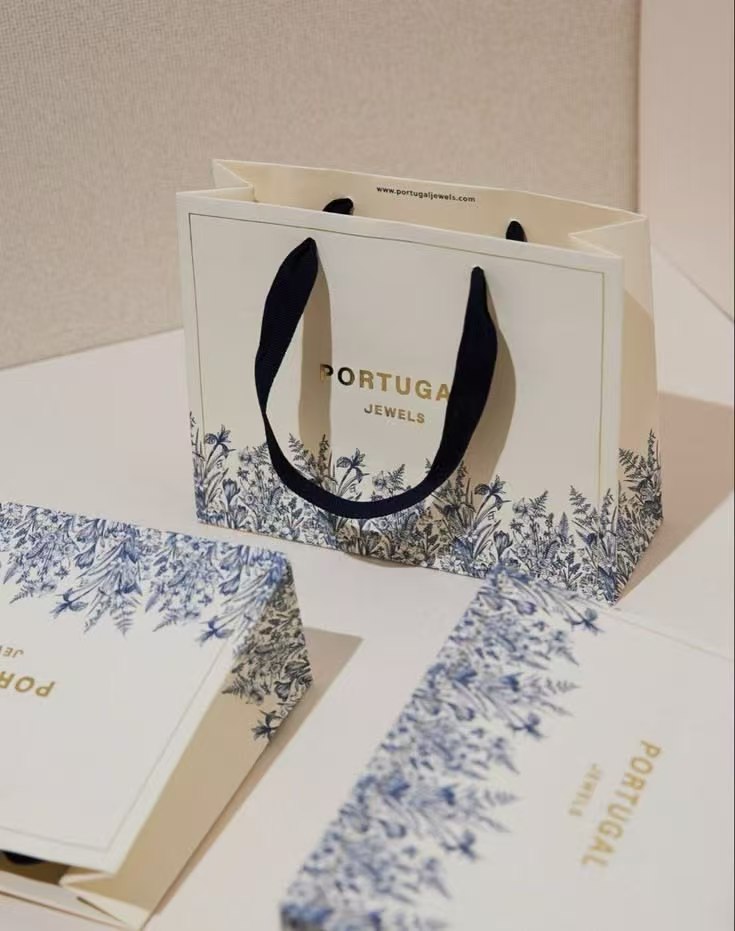
Paper bags, gift boxes, cards: one pattern, one colour standard—three formats, one visual identity
If you only do boxes and skip the bags, your brand is only halfway out the door. Packaging is a complete system—the moment a customer receives it at the counter, the paper bag, box, cards, and belly bands are all seen at once.
●Rigid Boxes: Lid-and-base, magnetic flip-top, drawer-style, and book-style, with greyboard from 1.5–3.0 mm matched to the desired feel
●Gift Bags: Cardstock, paper-twist handle, satin ribbon, and laminated bags, with 250–350g face paper and reinforced tops
●Inserts: EVA, molded pulp, flocking, foam, and satin, custom-shaped to product weight and form
●Paper Accessories: Cards, envelopes, belly bands, sleeves, and booklets, printed on the same paper and ink runs as the main box
Among the categories we've served, jewelry and watches, fragrances and cosmetics, premium foods, and hotel amenities are the most demanding when it comes to detail——and they all share one thing in common: the box is highly likely to be kept, so any compromise will be seen again and again.
The one thing clients dread hearing is "the mass production is a bit different from the sample." More often than not, the root cause isn't carelessness in production——it's skipped steps during sampling. We split sampling into three rounds, each addressing just one thing.
●White Sample (Structure): A 1:1 model in white card or greyboard, purely to test the feel, trial-fit the assembly, and set tolerances. Lid tightness, magnet placement, and whether the product sits securely——all decided at this step.
●Color Sample (Paper and Ink): Spot colors are printed on the same batch of paper used in mass production, with a color standard attached. Change the paper and the ink must be adjusted accordingly——so the color sample must lock in the paper.
●Process proof (foil stamping and embossing): We produce the foil stamping die and embossing die, then submit the first piece for sign-off. Foil stamping pressure, embossing depth, and registration are all confirmed in one go on this proof.
Proofing isn't about showing you a rendering—it's about catching the problems that would arise in mass production right here in our own workshop, before they happen.Standard blank proofs take 5–7 working days, and process proofs take about 10 days. Rush orders can run in parallel, but none of the three steps is ever skipped.
Luxury brands have virtually zero tolerance for color deviation—because customers will compare it against the one in the boutique, and the one in their hands may be from a batch two years old.
●Locked paper sourcing: For each project, we use a fixed paper mill and a fixed batch. Any batch change requires a new color proof.
●Hand-mixed spot colors: No four-color builds here—we mix ink to the exact Pantone number and archive a color swatch for every order
●Three-light proof approval: We check every proof under natural light, warm light, and spotlights. Gold cardstock can be deceptive—and spotlights even more so
●Batch comparison: We keep the finished product from the previous order and place the new batch side by side for a direct visual check—nothing ships until it passes
The same Pantone number can shift by two shade levels with a different batch of paper. The answer is never "let's tweak it again"—it's locking down the source.
More processes aren't always better. Paper can only take so much, and once you push past that limit, the box starts to look "dirty"——misaligned wraps, glue smears, bubbling on the surface, all of it.
●Establish one visual focal point first: if you're doing full-surface debossing, pair it with spot foil stamping; if the foil covers the full surface, leave white space and print a spot color. Clear hierarchy keeps it from feeling busy.
●The order of debossing and foil stamping: deboss first, then foil — the metallic layer follows the contours, giving strong dimensionality but a tendency to crack; foil first, then deboss — cleaner edges but shallower depth. Decide based on the pattern.
●No embossing for fine text: when stroke width is under 0.15 mm, the impression comes out blurry — better to use printing or foil stamping instead.
●Avoid gold cardstock for large-area foil stamping: poor adhesion and prone to flaking — better to switch to a matte specialty paper.
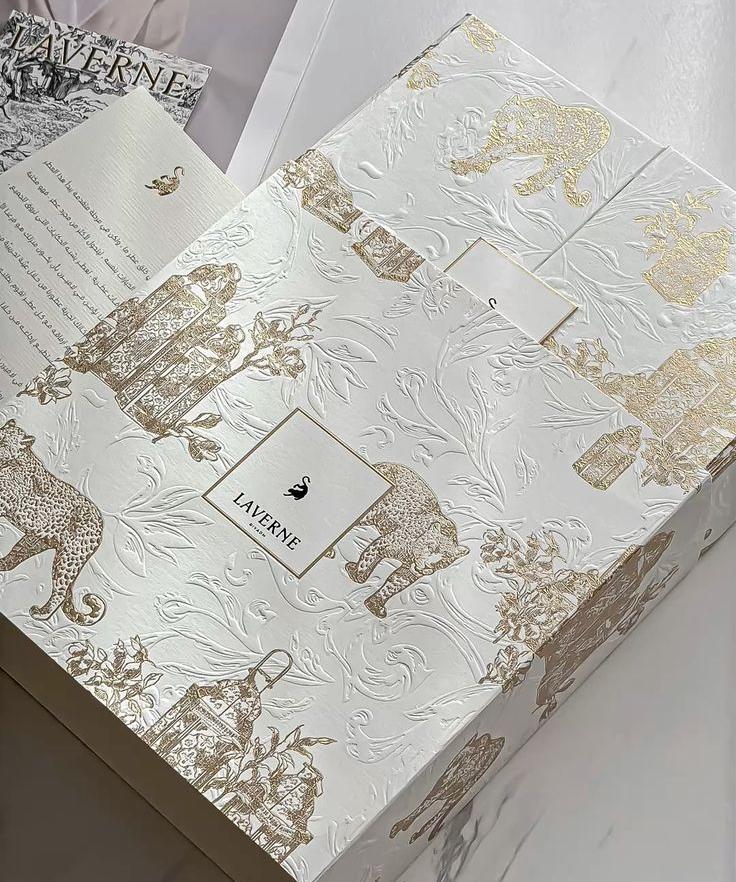
Full-surface debossing with spot foil stamping: the raised and recessed pattern is the first impression your hand registers.
The ritual of unboxing isn't mystique—it comes down to a few measurable numbers: magnetic pull, gap, damping, and lifting height.
●Magnets: Magnet size and count are matched to the box dimensions—secure enough to hold, yet no need to pry it open with your fingernails
●Lid gap: Kept between 0.3–0.5 mm—too loose and it wobbles, too tight and it won't pull open. This number is locked in on the white sample
●Insert lift: The product sitting 2 mm above the insert feels just right—easy to take out, yet it won't fall out on its own
●Reveal layer by layer: outer sleeve, lid, insert, card—the sequence sets the pace, so don't let the instructions sit on top of the main product
Structure is the part most easily cut from the budget, and the part users remember most. The cost you cut comes back at you in four words: "not premium enough."
Gift bags are what leave the store with your customers. They get carried down the street, photographed, set on dinner tables—their advertising reach lasts far longer than a box's, and they're far easier to get wrong.
●Stiffness: 250–350g face paper with a reinforced turned-edge top—the empty bag stands upright, and it won't sag when loaded
●Handles: Cotton cord, satin ribbon, paper twine, PP rope — whether a handle digs into your hand comes down half to rope width and half to hole placement
●Load Capacity: Standard models undergo destructive testing at 2–3 kg; a bag only passes if the rope holes don't tear and the base doesn't come unglued
●Matching Design: Patterns, spot colors, and foil stamping plates share the same files as the gift box, so everything matches as a set when carried out
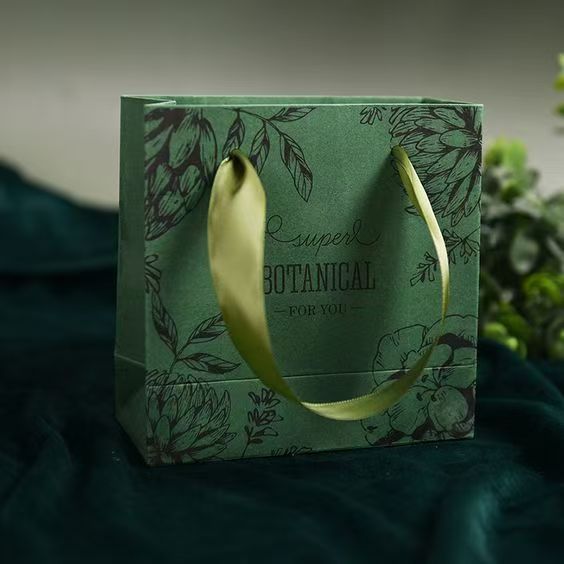
Dark green botanical line art with satin ribbon handles: bag body stiffness and handle feel are the two make-or-break factors for a gift bag
The most practical challenge for a new brand isn't the craftsmanship—it's "I only need three hundred units at a time, and in three different sizes."
●Split orders within the same structure: Keep the same structure and just change the size—swap the die line, not the process—so tooling costs can be spread across several SKUs
●Minimum order quantity: Rigid boxes typically start at 300 units, paper bags at 1,000; smaller runs can be discussed when the structure and process allow
●Version control: Assign a number to every retained sample and log each revision, so later batches don't mismatch earlier ones
●Ship in stages: Start with a small first batch and reorder once it sells well—your dies and plates stay on file, so reorders don't require new tooling
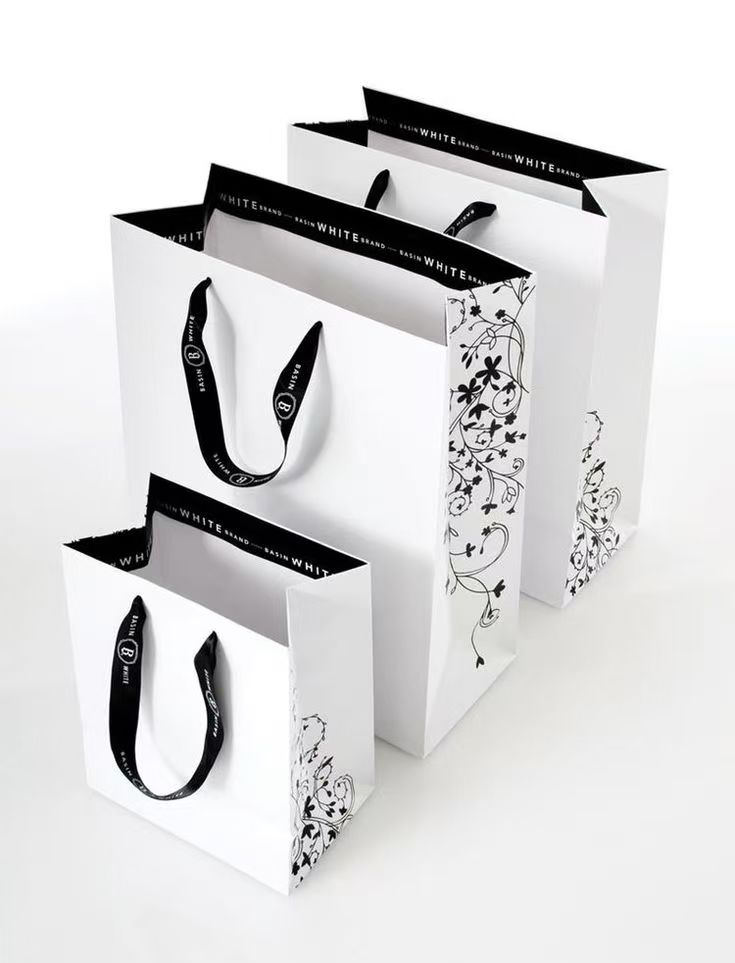
One visual identity, three sizes: a complete bag system holds a brand together better than any single style
Getting the box right is only half the job. The other half is logistics and quality inspection.
●Lead times: 15–25 days for standard orders; for peak seasons such as Mid-Autumn Festival, Chinese New Year, Valentine's Day, and Christmas, we recommend locking in capacity 45 days in advance
●Packing: Interleaving paper between boxes, corner protectors, and each unit bagged individually—treat them as finished products, not packaging. Foil-stamped surfaces are the most delicate; a single trip can leave them covered in scratches
●Inspection: Pre-shipment spot checks on three items—appearance, assembly, and load-bearing capacity—with inspection records provided
●Compliance: The mandatory national standard on excessive packaging sets hard limits on layers, void ratio, and cost proportion—gift boxes for food and cosmetics require advance self-inspection
●Materials: FSC-certified paper, molded pulp, water-based adhesives, and soy-based inks—test reports are available for any item that requires them
●Send Your Requirements: Box style, dimensions, paper weight, and finishing list—or simply a single image or a physical sample. Anything works
●Proposal: Structural proposal and quote within 48 hours, with a cost breakdown covering dies, plate fees, and unit price
●Sample Approval: Production begins only after white samples, color samples, and process samples are completed and approved; signed samples are kept on file
Your drawings and dies are used exclusively for your project and are never shared with similar clients; we are happy to sign a non-disclosure agreement if needed.
#Luxury Gift Box Customization #Premium Gift Bag Customization #Foil Stamping & Debossing #Magnetic Lid & Base #Molded Pulp Inserts #Low-Volume Customization #Packaging Manufacturer
CONTACT
恒屹文化 · Premium Custom Gift Boxes & Bags
Phone13661588485(Lucy)
Business Emailiroha@hengyi-culture.com
